Innovation Begins Where Existing Systems Stop Working
Some innovation begins in a laboratory. Some begins in the field, when established systems, processes, and technologies no longer match the environment in which people are being asked to operate.
OSI’s approach to research and development grew from both.
For more than two decades, our work has involved environments where communications, information, security, operations, technology, and human judgment must remain connected under changing and sometimes degraded conditions. That experience shaped an approach to innovation in which emerging ideas are researched, challenged, adapted, tested, and measured against the conditions they are intended to serve.
We are interested in new technology, but novelty is not the objective.
The objective is useful capability.
Research informs operations. Operations challenge research. The cycle continues.
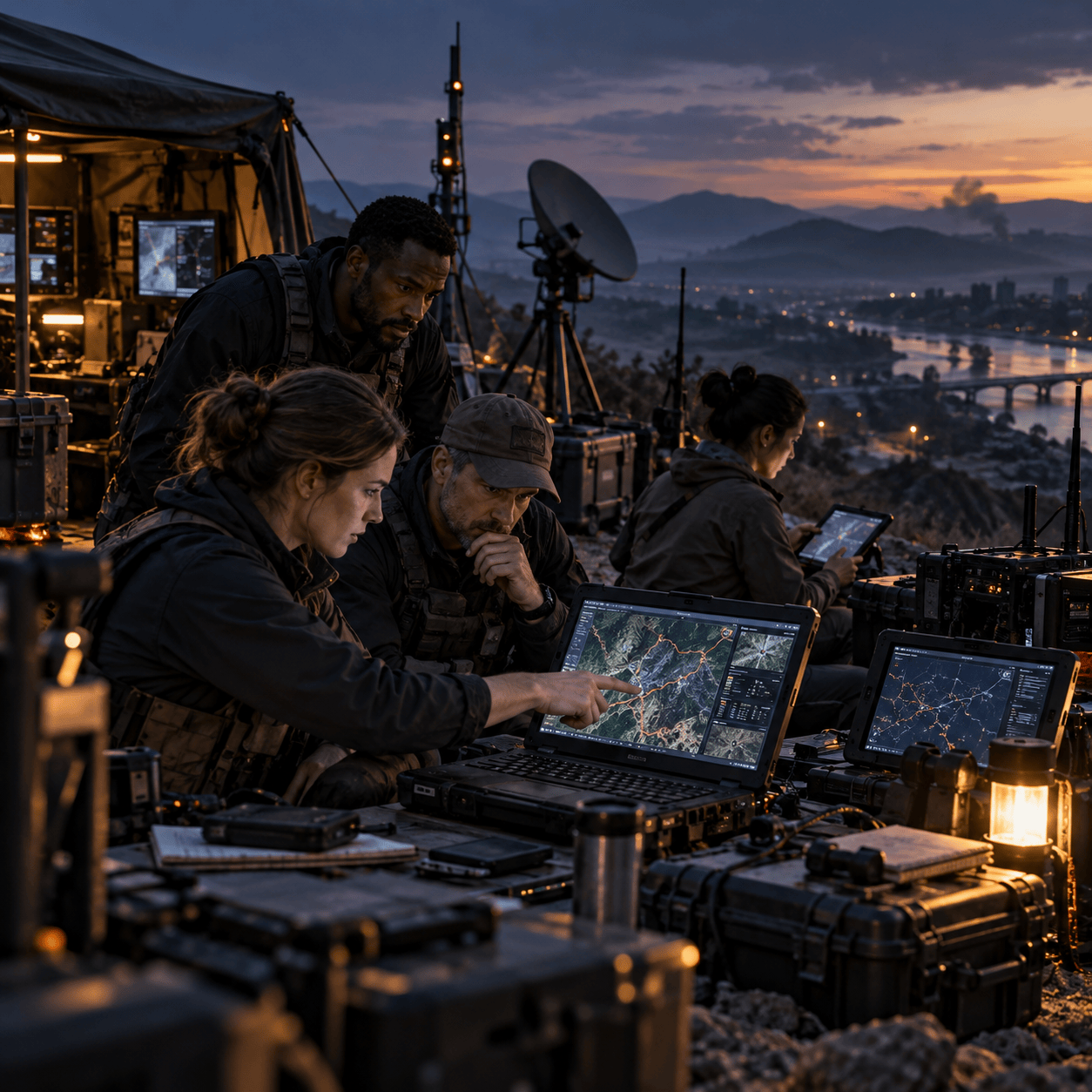

Networked Operations & Swarming
OSI’s work with distributed operations has deep roots.
Research into network theory, asymmetric operations, and the work of John Arquilla and David Ronfeldt influenced how OSI approached communications, collaboration, command and control, and the movement of information across dispersed teams.
During the Hurricane Katrina response, OSI deployed mobile communications systems combining wireless networking, mesh technology, satellite connectivity, field intelligence, and distributed command-and-control support. The architecture was designed around small operational elements able to remain geographically dispersed while maintaining connectivity and shared awareness. Your later documentation explicitly describes those systems as agile tactical networks capable of swarming.
The contemporaneous Katrina record shows the operational reality behind that language: OSI provided strategic and tactical communications, command-and-control support, intelligence collection and field analysis, image feedback, disparate-network support, reconnaissance, remote surveillance, and RF and satellite communications. OP-Katrina AfterAction9-2005 1
That work later contributed to OSI’s participation in the Department of Defense-sponsored Strong Angel III exercise at San Diego State University, where small distributed OSI elements continued to demonstrate the ability to move information, resources, and personnel rapidly while remaining connected to command elements located far outside the immediate operating area.
Emerging doctrine became operating capability. Operating experience created the next research question

Stealth Innovation & Applied R&D
Protect the Learning Before Scaling the Claim
Not every idea should immediately become a product.
Stealth Innovation is OSI’s disciplined approach to working with emerging problems and capabilities before commercial pressure, public expectations, or premature certainty distort the learning process.
The work may involve research, technical reconnaissance, data analysis, experimentation, prototyping, operational testing, or the integration of established technologies in an unconventional way. Some concepts mature into capabilities. Others change direction. Some should stop altogether.
That is part of responsible innovation.
OSI’s own history demonstrates this cycle:
Observe → Research → Adapt → Build → Deploy → Learn → Refine
Modern analytics and artificial intelligence add significant capability to that process. Descriptive analysis helps establish what has occurred. Predictive analysis helps explore what may follow. Prescriptive analysis can help leaders examine possible actions and consequences that might otherwise remain unseen.
Yet technology remains part of the decision environment rather than its sovereign authority.
Experiment boldly. Validate carefully. Keep human judgment in command.

Intelligent Social Media™ & Secure Collaboration
When Information Tempo Becomes an Operational Problem
Intelligent Social Media™ grew from a recurring research question:
What happens when information moves faster than organizations can securely understand, share, and act upon it?
OSI’s research examined the relationship between information tempo and operational tempo, as well as the effects of information overload, open networks, asymmetric communication, emotional response, security, collaboration, and human behavior.
The resulting Intelligent Social Media framework explored a different kind of digital environment – one built around proactive engagement, controlled information flow, social and emotional intelligence, secure and agile networks, and collaboration structured around operational needs.
The work also deliberately extended Arquilla’s network and swarming concepts beyond their military context.
ISM therefore represents more than the development history of a software platform.
It represents a continuing line of inquiry into how technology, networks, people, information, security, and decision-making can work together without sacrificing the human relationships upon which meaningful collaboration depends.
The research continues.
Intelligent Social Media is currently undergoing renewed technical, infrastructure, security, product, and market evaluation. Public capability claims will reflect verified current status as that work progresses.
Analytics, AI & Emerging Technology

Better Information Should Produce Better Judgment
Business intelligence, advanced analytics, automation, and artificial intelligence are changing what organizations can see, analyze, and accomplish.
OSI studies those capabilities as part of a larger decision system.
Data must be collected and prepared correctly, and models must be understood within their limitations. Predictions require context, and automation requires oversight. Leaders remain responsible for what organizations choose to do with the information technology makes available.
The opportunity and the responsibility are substantial.
Technology can increase what leaders know. It cannot relieve leaders of the responsibility to exercise judgment.
The Work Has a History
OSI’s research and innovation work spans operational deployments, technology development, networked communications, disaster response, secure collaboration, organizational change, analytics, artificial intelligence, risk management, and the study of human behavior inside increasingly complex technological environments.
We are now organizing that history into a growing library of case studies, research papers, operational lessons, and technical narratives.
The purpose is not to prove that every experiment succeeded.
It is to show what was attempted, what was learned, what evidence supports the result, and how those lessons continue to inform the work being done today.
Case Studies Coming Soon…
Hurricane Katrina & Strong Angel III
Distributed operations, resilient communications, swarming, and interoperability.
Network Theory & Swarming
From Arquilla and Ronfeldt to applied OSI operational doctrine.
Intelligent Social Media™
Information tempo, secure collaboration, and human-centered networks.
Human-Centered Analytics & AI
Descriptive, predictive, and prescriptive analysis under accountable human judgment.
There are multiple case studies to follow… and coming soon. So, come back soon!