OSI LEADERSHIP FORESIGHT BRIEF
Strategic Margin: Leadership Before Events Take Away the Choices
September 10, 2026
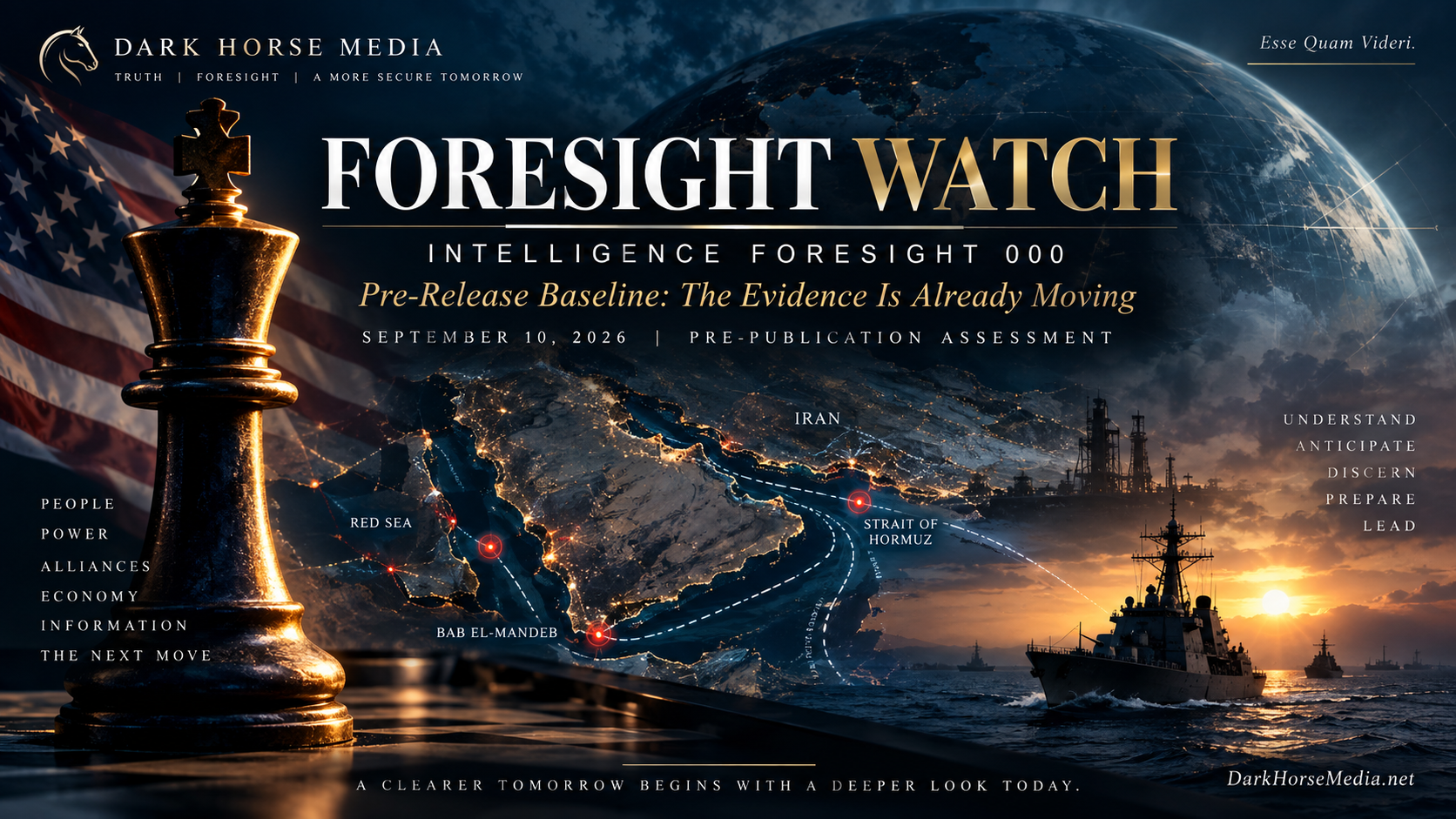
Tomorrow, Dark Horse Media will release Do We Need a King? and begin the public phase of Foresight Watch. At OSI Network, our role in that work will be different.
Dark Horse will examine what the evidence may mean at the level of national power, government, conflict, economics, institutions, and strategic competition. OSI will ask what those same events can teach those of us responsible for organizations and people.
This distinction is important because, although the scale may vary, leadership dynamics typically remain consistent. The recent events in Iran, global shipping, Canada, China, and the Middle East offer a good initial case study.
Foresight Is What Leaders Do Before the Crisis Makes the Decision for Us
Robert Greenleaf called foresight the “lead” that a leader possesses. His warning was severe: when that lead is lost and events begin forcing the leader’s hand, leadership becomes reaction rather than direction.
Daniel Kim later developed that principle by distinguishing foresight from precise forecasting. Leaders cannot calculate a complex future with certainty. They can, however, understand the underlying structures of their organizations and environments well enough to anticipate directional consequences and make better choices before those consequences arrive.
That distinction is immediately visible in the current Iran conflict.
An initial military objective has accumulated additional requirements involving force protection, tanker interdiction, economic warfare, commercial shipping, regional allies, energy markets, and now a renewed Houthi theater near another strategic waterway. CENTCOM’s September 8 announcement concerning five Iranian oil tankers and the subsequent expansion of Houthi control along Yemen’s Red Sea coast demonstrate how quickly one problem can begin creating several related ones.
For organizational leaders, the lesson is not about Iran.
It is about strategic margin.
A new project rarely consumes only the resources identified in the project plan. It generates coordination requirements, new risks, additional meetings, dependencies, personnel fatigue, budget pressure, communications demands, political considerations, and unforeseen second-order work. The larger the undertaking, the more consequential those hidden obligations become.
A leader who continually adds objectives without understanding their cumulative effects may still appear decisive. The organization may even achieve each individual task. Yet underneath the apparent success, resilience can be disappearing.
Servant Leadership encourages us to recognize that the individuals carrying out the mission are not expendable parts of the leader’s ambitions.
Relationships Are Strategic Assets
The U.S.–Canada dispute provides another useful lesson.
The United States can impose economic pressure because it possesses enormous economic leverage. Canada can retaliate because it possesses leverage of its own. The result is not simply a contest over tariff percentages. It becomes a question of trust, predictability, investment, dependency, and the future value each side assigns to the relationship.
The Bank of Canada has now incorporated the effects of U.S. tariffs and Canadian countermeasures into its assessment of inflation and economic uncertainty. At the same time, Prime Minister Mark Carney’s decision today to describe the latest American measures as relatively modest and avoid immediate escalation demonstrates that stressed relationships can still retain room for restraint.
There is a leadership lesson here that businesses, ministries, military units, police agencies, and government organizations should understand.
Trust is not a fragile or easily broken asset.
It is operating capital.
Leaders spend relational capital when they surprise partners, humiliate subordinates, change agreements unpredictably, dismiss expertise, or misuse authority. Sometimes necessary, but leaders unbalanced risk damaging relationships when they need them most.
Servant Leadership does not require the avoidance of hard decisions. It requires recognizing that the people affected by those decisions matter to the future of the mission.
Competitors Adapt to the Systems We Build
Today’s reporting concerning the Iran–China trade mechanism offers a third lesson.
American sanctions were designed to restrict Iran’s access to international financial systems. Iran and China appear to have responded by constructing an alternative arrangement that transformed Iranian oil proceeds into credits used to finance Chinese goods. Reuters estimates that billions of dollars may have moved through the mechanism during the past year.
Whether a national-security practitioner or a market executive, the principle is familiar: people, competitors, employees, customers, and adversaries all adapt. Every policy shifts incentives, prompting those affected to find ways through, around, or away from the structures we build.
This is one reason leaders must be careful about interpreting compliance as success. A rule may produce the behavior we can see while simultaneously generating workarounds we cannot.
Foresight therefore requires more than asking, “Did our decision work?”
It requires asking, “What behavior did our decision create elsewhere in the system?”
That is a very different question.
Listening Is Part of Foresight
The connection to Servant Leadership becomes even more important here.
Spears’s synthesis of Greenleaf’s work includes listening, awareness, conceptualization, foresight, and stewardship among the central characteristics of the servant-leader. Later Greenleaf Center work makes the relationship among those characteristics explicit: listening creates conditions for awareness; conceptualization allows the leader to see the larger picture; foresight anticipates consequences; stewardship recognizes that leadership is exercised on behalf of something larger than oneself.
This matters operationally because the people nearest to the work often detect weak signals before senior leadership does.
The patrol officer notices a developing street condition, the analyst detects an anomaly, the cyber engineer finds a vulnerability, the supervisor senses morale issues, the employee detects demand changes, the pastor notices withdrawal, and the military operator perceives unseen environmental factors. If organizations discourage sharing inconvenient info, leadership blinds itself.
The servant-leader listens not because listening is polite, but because listening is part of how responsible authority sees.
When Helping Others Becomes Meddling
Kim raises another question that belongs in almost every leadership classroom: how does a leader know whether an intervention is actually helping?
Intent is not enough.
A leader can sincerely believe he is helping while repeatedly changing a system in ways that increase instability. Kim uses this distinction between helping and meddling to show why foresight requires understanding the structure producing an outcome rather than simply responding to the latest deviation.
That has enormous relevance in contemporary organizations.
Remember, not every disappointing metric means a new policy is needed, and not every conflict calls for executive intervention. Sometimes, public criticism doesn’t need a response, and operational setbacks don’t require a complete reorganization. Even anxious moments don’t always call for another initiative. Frequently, a leader who is always trying to ‘fix’ the organization may actually be contributing to its fluctuations.
That is why foresight requires enough humility to ask whether our own leadership behavior is part of the system we are trying to repair.
The Stewardship Question
This is where OSI’s participation in Foresight Watch will ultimately live.
We will take significant Intelligence Foresight assessments and ask what they teach about the stewardship of people, resources, authority, trust, information, resilience, and organizational capacity.
Greenleaf’s test of the servant-leader was never simply whether the organization achieved its objective. It asked what happened to those who were served: whether they became healthier, wiser, freer, more autonomous, and more likely themselves to serve.
It suggests that a leader’s responsibility goes beyond today’s report. We should ask if our decisions strengthen or weaken people, foster a culture of truth or fear, build resilience or drain reserves, and help followers develop good judgment.
That is foresight as an act of service.
It is also where Servant Leadership begins moving naturally toward the idea of Stewarded Power.
Leadership possesses real power. Sometimes it must be exercised decisively. But if power is entrusted rather than owned, then the leader must eventually answer a question larger than whether the decision could be made.
We must ask what happened to everything entrusted to us after we made it.
That is the conversation OSI will continue.
Selected Intelligence Foresight reports will originate through Dark Horse Media’s Foresight Watch. Here at OSI Network, we will translate those developments into practical learning for leaders working in business, government, law enforcement, military service, technology, ministry, and organizational life.
The news gives us events.
Our task is to learn from them before they become hindsight.
OSI Network
OSINetwork.com/osi-blog-posts/
For the underlying Intelligence Foresight analysis and Do We Need a King?, visit DarkHorseMedia.net.

Leave a Reply